Friday, 27 September 2013

Dangers of Pets Abroad


Last year when I went to a talk at the local vets about lungworm, the representative mentioned that she believed that the diseases in the UK would change dramatically due to a new law that was introduced on the 1st January 2012.

This law is in affect to save pet owners hassle and money.  But what effect will it have on the population on the UK’s pets?

The law before the 1st January 2012 was:

UK Pet Travel Scheme allows cats and dogs to enter the UK from an EU member state or a ‘listed’ 3rd country provided that they are microchipped, have been vaccinated against rabies, have had a blood test to confirm an adequate serological response, and have waited for 6 months after the blood test before entry into the UK. Animals must be treated against ticks and tapeworms 24-48 hours before entry into the UK. All treatments must be recorded in a pet passport or 3rd country veterinary health certificate. Pets from ‘unlisted*’ 3rd countries are required to spend 6 months in quarantine.

*An ‘unlisted’ country is any country not included in the list of EU and non-EU countries that is considered high risk for diseases such as rabies.

The law now:

Dogs, cats and ferrets entering the UK from an EU member state or a ‘listed’ 3rd country will still need to be microchipped and to be vaccinated against rabies. However, a blood test will no longer be required, and the waiting period after vaccination will be reduced to 21 days. Tick treatment will not be required. Dogs entering the UK must have been treated by a veterinary surgeon against tapeworm one to five days previously.

Dogs, cats and ferrets entering the UK from an unlisted 3rd country will no longer be required to spend 6 months in quarantine provided they enter the UK through an approved route and meet the EU entry requirements (microchip, rabies vaccination, blood sample at least 30 days after vaccination, and a wait of 3 months after the blood sample). Tapeworm treatment is required as above.

The advantages to the new law:

  • ·         It will make going on holiday much more accessible to people who rely on animals for assistance.
  • ·         It will also be easier for people who have two houses in different countries to be able travel without the hassle of quarantine.

So what effect will this have to the wider population?

The decrease in cost and hassle of being able to take your pet on holiday with you will invariably encourage many owners to take their pet away with them, which will lead to an increased chance of diseases not currently in the UK to be brought in from other countries.

This will have a serious effect on not only the health of the animals, but also human health.  The vets are struggling as it is to keep up with the mutations of parasites and diseases currently in the UK without new problems coming in from other countries. 

For example; at the moment the UK are trying to stay free from dog tapeworm (Echinococcus multilocularis) which is known to occur in the following countries of Central Europe: Belgium, Luxembourg,  France, Switzerland, Liechtenstein, Austria, Germany and Poland. “Although [the tapeworm is] relatively benign in dogs, the resulting disease in humans – alveolar echinococcosis – is an invasive, cancer-like cystic stage of the parasite, and is invariably fatal if not treated.”

These are some of the more common diseases that your pet may pick up abroad (and what they are spread by):

  • Leishmaniosis (Sandflies)
  • Heartworm (Mosquitoes)
  • Babesiosis (Ticks)
  • Ehrlichiosis (Ticks)
  • Echinococcus multilocaris - Tapeworm (small rodents if eaten)
  • Rabies (bite/saliva from another infected animal)

  Those of you who follow my blog will remember my post on Schmallenburg in livestock and the devastation that caused in many parts of the UK, that disease is also transferred by mosquitoes so we already know that mosquitoes have the potential to bring disease from Germany to the UK.

And with the law removing the need to have tick treatment to re-enter the UK there is also the potential for babesiosis and ehrlichiosis to be brought in.

 So what is my view?

 My view is that unless it is 100% necessary to take your pet abroad, leave them at home.  It is not worth the risk to your animals health and human health.  Please consult your vet if you have any concerns or queries about travelling abroad with your pet.

for more information on the requirements to take your pet abroad visit: 
https://www.gov.uk/pet-travel-information-for-pet-owners


I have referenced the BSAVA, ESCCAP and DEFRA websites in producing this post.


Wednesday, 4 September 2013

Alternative to Pet Insurance

I was speaking to someone in my village when I was walking my dog and they were telling me about how they went about paying for their pets' vet bills.  They have a massive leonberger dog and had 3 cats and it was impossible for them to find anyone that would insure their dog at a reasonable price.

As nothing is 100% guaranteed to go wrong with one pet but 101 things may go wrong with another, insurance can sometimes lose or save you money and it usually comes with an excess (you have to pay a certain amount before the insurance company will pay out. eg. excess of £100, bill of £500 you pay £100 and they pay £400) and sometimes the condition your pet has might be in a sneaky clause that says the insurance will not cover you for x,y, or z.

The way they put aside money for the dreaded vet bills was that they had a bank account that they put however much it would cost to insure the cats each month into this bank account and if anything was to go wrong with the pets they would use the money specifically for the pets in the bank account.  This paid off because although unfortunately the cats had to be put to sleep (the condition was not such that the cats could recover) - they both had strokes - age 2 and 12.  As euthanasia is relatively cheap compared to any operation they still had money left over which came in useful when their dog a few months later had a £900 operation on her foot to remove a tumour - which if they had not put the money away, the operation would not have been possible.  In this particular case they would have been paying out for the cats (for which would have not been helpful) and had no money set aside for their dog.

This is just something to make you think and NOT telling you to do this or not to do this.  Whichever you pick it is a risk as both ways have the potential to save you a fortune or lose you a fortune as it is a risk due to the cost of insurance that may or may not be necessary and if you don't insure then the cost may be more than you have had chance to save by putting away the cost of insurance each month.  My dog is insured for £14 a month and so far *fingers crossed* she has had nothing that we needed to claim on the insurance for, however, my grandma has just claimed a lot (don't know exact figures) for tumours around the eyes that needed removing.  But as shown above this way benefited for this family.  Please see my Pet Insurance post for more information on that.

But which ever method you decide to use to put aside money for operations etc it is your decision and I am sure there are even more options depending on your circumstances.  But I HIGHLY RECOMMEND you definitely put money away/insure in case something does go wrong.  People think it doesn't happen to them but it does.  At my time on work experience I have seen multiple animals having to be sent to cat or doggy heaven because the owners simply cannot pay.  For example just the other week a 2yo cat that needed surgery to either fix or amputate. Fix - very expensive.  Amputate - about £600.  Euthanasia - £60.  However, the next day a cat that had been hit by a car needing a slightly different operation - displacement of hock - that needed drilling and tying the bones back together had the option of surgery as it was insured.  Things do go wrong so make sure you are prepared! It may just happen to you!

Sunday, 25 August 2013

Laminitis

The 8th June was Laminitis Awareness Day.

Laminitis is too common in horses, ponies and donkeys. According to vets it is the second biggest killer of horses after colic in the UK. 

So what is laminitis? 

 We have all heard lots about laminitis and usually associate it with fat ponies like the ones in the Thelwell cartoons who have eaten too much spring grass. However, any type, shape or breed can get laminitis and horses with hormone disorders - such as Cushing's disease and Equine Metabolic Syndrome - can get laminitis without being overweight. 90% of horses with laminitis have an underlying hormonal disease. Also although laminitis is considered to be a disease that occurs in spring it actually occurs all year round!

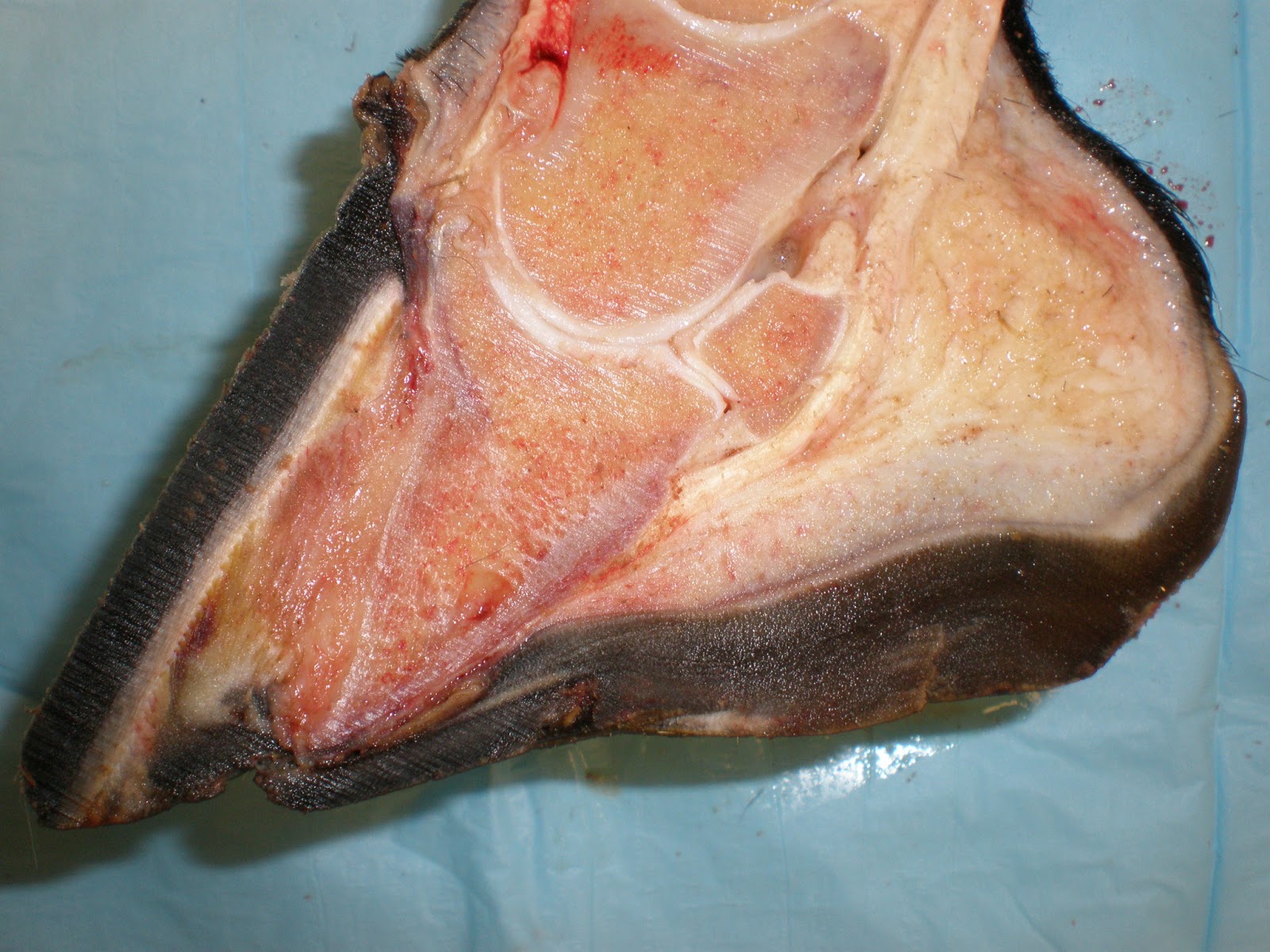
Laminitis is an inflammation of the laminae, the sensitive tissue that attaches the pedal bone to the hoof wall.  This inflammation contributes to the pain that causes the horse or pony to be unable to stand.  In some cases, the delicate bonds that hold the pedal bone in place can fail and the pedal bone sinks and/or rotates inside the hoof capsule. Horse&Hound

This picture shows the rotation of the pedal bone
or simply for the non-horsey: inflammation of a horse's feet, caused by eating too much rich grass.

The most common cause is excessive fat deposits, which creates a toxic reservoir in the horse's body.  This produces anti-inflammatory proteins and these circulate in the body causing havoc and 'priming' the animal to develop laminitis. Your Horse

 Is your horse at risk? Is your horse...

  • Overweight?
  • In a poor routine, or made vulnerable by a change of routine or environment?
  • Living in a stressful environment? (excess travelling, competing or separation anxiety?)
  • Receiving poor or irregular foot care?
  • On medication? (some drugs can cause laminitis, notably corticosteroids- a type of anti-inflammatory)
  • Heavily competed on poor ground?
  • If a mare, is she hormonal or in-foal?

 Symptoms:

 Reluctance to walk and bear weight, heat in feet, bounding digital pulse around the fetlock, rocking back on heels.

If you see the above symptoms - CALL THE VET URGENTLY.

Recovery:

Corrective farriery will be needed and dependent on the severity of the laminitis the horse may be able to return to work provided there is no pedal bone rotation or sinking.  After the amount of box rest prescribed by your vet you will be able to walk in hand and build up work very gradually so that the laminae recover and get used to the amount of work.  If you work your horse too hard when the laminae are too weak you will have to return to step 1.  Your vet will advise you on the amount of exercise you should be giving your horse on an individual case basis.  You should always stick to soft surfaces and your vet will also advise you on when you can begin to turnout again and how much turnout to allow.  If the pedal bone has rotated or sunk remedial farriery will be necessary and a much longer amount of box rest will be needed.

Remedial shoeing may include: Imprint shoeing, Natural Balance shoes, Heart Bar shoes and Steward Clogs.

Animals with a history of laminitis are 4X more likely to get it again


Prevention:

  • Restricted grazing- either using a grazing muzzle, strip grazing (only giving them a very small amount of grass), or turning him out at night when there are fewer fructans in the grass (but make sure the paddock is secure and thief proof as there will be less people around at night to keep an eye on him).  Reducing the amount of time grazing will not help as they can consume a large proportion of their daily intake with just an hour at grass.
  • Don't turnout on frosty pastures, especially in bright sunlight.
  • Get your horse tested for a hormonal condition and treat if necessary.
  • Ensure your horse is a healthy weight.  (There is a difference between fat and muscle)
  • Feed low starch, low sugar diet according to workload.  Laminitis can be due to excessive starch or a high intake of fructan sugars, however, make sure your horse gets all the vitamins and minerals it needs.
  • Watch grass growth-fructans are highest when grass is growing - especially warm damp spells.
  • Soak hay to further reduce its fructan and calorie content then feed 2.5% of his body weight in 2-3 small holed haynets will slow him down eating it.
  • All treats and hard food should be avoided.
  • Exercise! It helps the horses metabolism which reduces the risk of obesity.
  • Keep an eye on weight gain/loss and body score him regularly.  Horses naturally lose weight in winter and gain weight again in spring so do not go over the top in winter with his weight to stop him losing it (not too much, if you are worried about excessive weight loss contact your vet), make the most of being able to lose the weight he put on last summer.


Saturday, 24 August 2013

My Crazy Summer!

Sorry for the absence of posts lately.  Before June I was busy preparing for my GCSE's - which was worth it because I found out a couple of days ago that I got 8A*s and 2Bs! A*s in Biology, Chemistry, Physics, Maths, History, French, Latin and PE and Bs in English Literature and English Language :) I am very happy and am over the minimum grades to apply for veterinary medicine at university.

With the pullets
And from June till now I have literally not had a spare moment!  First I had an amazing time at a chicken and dairy farm and learnt so much from invaluable experience there from numerous people with a wealth of knowledge and I also now have a new love of chickens :)


 Then I went to America for 2 weeks, while I was there I visited Busch Gardens and spent most of the day in the animal care center watching Pixie Frogs, Uromastyx, Blue-tongued Skinks and a variety of other animals undergo veterinary treatment.


One of the calves
Then I spent a week on the North Yorkshire Moors at a stables, riding and doing general horse care.

Lemur attack!
After that I spent 2 weeks at Blackpool Zoo and it was an amazing experience! We had theory sessions and practical sessions.  The practical sessions were very informative and I learnt loads of new things! Such as a snail is an ectothermic thigmatherm! It also encouraged me to want to do a few blog posts on more exotic animals as a huge amount of animals in the wild are under threat of potential extinction!

With a wallaby at Blackpool Zoo.
The practical sessions involved getting up close and interacting with a variety of animals and learning about their day to day care and potential health problems and their management in captivity.  For example: the camels at the zoo had saggy humps.  In the wild this would indicate a health problem, but, in captivity where they have access to water daily they have no need to store the fat in their humps so their humps become saggy.  The management of animals in captivity is also interesting and they employ researchers to sit and watch the animals and monitor their behaviour in response to different stimuli.

After that I did a week at a local vets and it was very good experience - lots of cleaning - but that can be expected if you are wanting work experience in a vet practice because as a reward I was given invaluable experience and allowed to listen to patients hearts and lungs and watch really interesting operations!  Like a lumpectomy where the lump was about as big as a melon!


So to conclude what has been a very busy summer I have a few days off before school starts on Thursday to post as many blog posts as I can - including the promised post on laminitis - and get everything sorted for school - and maybe even a rest!

Saturday, 8 June 2013

Laminitis Awareness Day

Just to inform you today is Laminitis Awareness Day.  Slightly busy at the moment with GCSE's, however, a post will follow shortly!


Thursday, 14 March 2013

NEW Microchipping Law

Following my prior post on micro-chipping there has been a new government legislation to try and decrease the number of strays.  Every dog owner in England will have to microchip their animal from 2016.  Failure to comply will mean fines.  More information here,

Sunday, 24 February 2013

Lungworm (Angiostrongylus vasorum)

I recently went to a talk by representatives from BAYER at my local vets.  It was primarily about lungworm but other parasites were also included.  My local vets held the talk as 2 dogs had been lost to lungworm recently at the practice.


Where is it found?

 The adult of this particular lungworm resides in the heart and pulmonary artery - the major blood vessel supplying the lungs.

Unlike most worms that you can see the larvae of if passed in faeces this type of lungworm's larvae is microscopic and vasorum adults are slender worms of around 2.5cm in length but they are never seen as they remain inside the infected dog or fox.

How can my pet get lungworm?

This advertisement was made with a treat where the snail is and the snail (which they enlarged) was then computerized over the top.  No dogs or snails were harmed.


Tiny snail

Pets can get this life-threatening parasite by swallowing infected slugs, snails or frogs.

You may think "but my dog doesn't eat slugs or snails it can't be at risk?" 

However slugs and snails can be very small; even if dogs don’t eat slugs and snails on purpose, they may do accidentally when eating grass, drinking from outdoor water bowls, rummaging in undergrowth or playing with a toy outdoors.

Symptoms:

Symptoms can be varied, but can include, coughing, tiring easily, weight loss, poor appetite, vomiting, diarrhoea, excessive bleeding from minor wounds and seizures. A dog may show one or any combination of these or show none at all!

  • If treatment is initiated early enough, dogs can go on to make a full recovery
  • If left untreated, this parasite can be fatal to dogs
  •  Even after successful treatment, re-infection is possible so on-going preventative treatment should be considered.

 I think my pet is at risk?

 Due to the serious nature of this parasite a regular preventative treatment should be considered if you frequently see slugs or snails in your locality. Slugs and snails are on the increase and dogs can swallow these accidentally. Standard wormers do not prevent this parasite; so speak to your vet for more advice.

How to prevent the spread?

Here are some general tips to help prevent the spread of worm eggs in the environment and thus reducing the risk of your pet from contracting them.
  • Always dispose of your pets’ poo to limit environmental contamination with worm eggs
  • Keep your pets’ bedding clean
  • Regularly clean cats’ litter trays
  • Keep pets well groomed

Is it a threat to me?

Angiostrongylus vasorum (lungworm) is not considered a threat to human health

 Dogs infected with lungworm spread the parasite into the environment, as the larvae of the parasite are expelled in the dog’s faeces. This increases the chances of other dogs becoming infected.

The parasite is relatively new in the UK. It first emerged in France but has since spread to many countries in Europe, Africa and the Americas. It is endemic in several parts of England mainly in the South however a small handful of suspected cases have now occurred north of the border in Scotland, since the first reported case in the central Scotland in 2008.

Unfortunately the restrictions and checks for pets travelling abroad and back into the country are becoming more slack so there may be new cases of even more dangerous parasites from abroad infecting the pets of Britain in the future.

If you want anymore information about lungworm either speak to your local vet or visit Bayer's website: http://www.itsajungle.co.uk/


Monday, 21 January 2013

Schmallenberg Virus

SOME PEOPLE MAY FIND IMAGES IN THIS POST DISTRESSING.

Schmallenberg virus was named after Schmallenberg, Germany as it was where the first definitive sample was derived. It was initially reported in 2001 so is a relatively new emerging livestock disease. The virus has been associated with brief mild/moderate disease (milk drop, pyrexia, diarrhoea) in adult cattle and late abortion or birth defects in newborn cattle, sheep and goats.  It is spread by vectors (mosquitoes, midges etc.)

 It affected European countries nearer Germany but spread to the UK with the first confirmed case in January 2012. The government's Chief Veterinary Officer, Nigel Gibbens,
"We've seen quite rapid geographic spread," repors the government's Chief Veterinary Officer, Nigel Gibbens. "Some will - in those herds and flocks we expect an impact of 2-5% of their lambs and 
A stillborn calf affected with the Schmallenberg virus
calves." 


This will obviously cause a great impact on the financial profit of the farmers. 


"The infection has been transmitted through the whole of England and Wales, effectively, up to the Scottish borders”
Alasdair Cook Animal Health Veterinary Laboratories Agencies

A stillborn lamb also affected

Cases have been documented on 976 farms in England and Wales, compared with 276 in August.
However, officials believe the true number of cases is higher. The first sign is often when livestock give birth to deformed or dead young - which can be months after the infection has occurred. 

As it is very early in the lambing season it is not yet possible to tell how much of an impact this outbreak will have.  I do have a placement for lambing this year so will be interested to find out what farmers think of this disease first hand .


However, there is a vaccine being developed and it is hoped-if it is safe and effective it could be in place in time for next years lambing season.


***UPDATE AFTER LAMBING PLACEMENT***
There was no Schmallenberg cases at the farm I worked at.  However some local farms did have horrendous outbreaks resulting in a very damaging lambing season for finances due to a lot of stillborn lambs.